[caption id="attachment_3245" align="alignnone" width="580"]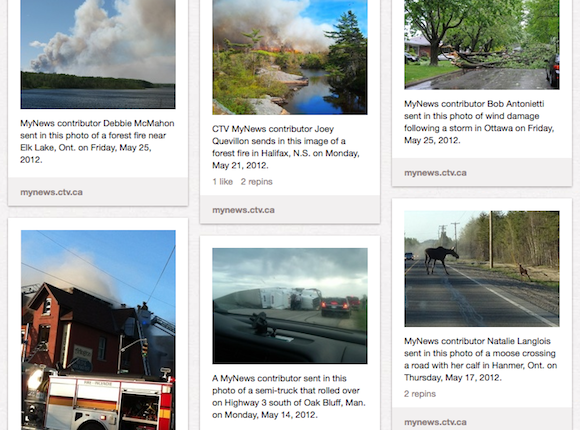 A screengrab from CTV News' "Canada through your eyes" board[/caption]
Another social network. If you're already fatigued by Tweeting, Facebooking and Tumblring every time you publish a new story or photo, the suggestion you should "pin" it too might sound downright exhausting (and redundant). But some news organizations and journalists on Pinterest—where users pin images and text to boards organized by subject—are finding it's an effective way to engage readers and reach new audiences.
Should you try it out? We can't give you a "yes" or "no," but what we can provide are some tips we've gathered from around the web to help you decide if you should use Pinterest professionally. If you've found other valuable resources on this subject that we missed, please share them in the comments.
- Who will you reach by sharing your work on Pinterest? The dominant story about demographics and Pinterest has been, from the start, that it's dominated by women. And according to data from March, that's still true (72 per cent of users are female), though men are using it more (up 8 per cent from two months earlier). If you want to reach kids, teens, undergrads or seniors, look elsewhere: the vast majority of users are between 25 and 54. Lastly, people who Pinterest are consumers: they have higher than average incomes (nearly 30 per cent have $100k+ annual incomes, says Mashable), and their interests tend towards lifestyle areas like fashion, music, food, decor and crafts.
- What do journalists do on Pinterest, though? Media Bistro's 10,000 Words posted "5 Ways Journalists Can Use Pinterest" in January, a sort of aspirational list that includes sharing the news, giving readers a sneak peek of upcoming stories, and posting photos of newsroom staff (huh?). These might be ways that journalists would like to use Pinterest, but, in a more recent post, Steve Buttry offers more realistic suggestions that seem to align better with Pinterest's demographics and dominant content areas. Buttry sees journalists and news organizations using it to share "lifestyle coverage, contests, community information and events and photography," noting that he hasn't seen it used for breaking news coverage but "that could change."
- Want more ideas? There are many more, from Mashable, Poynter, Journalism.co.uk, the Nieman Journalism Lab and even some specifically for individual writers, from Ebyline, and for freelancers, from SimplifyThis. Browse away, but first go do some browsing on Pinterest and see what kind of content is being pinned. Will your stories and images be able to compete with all the pretty, shiny things? A mix of news and lifestyle uses that favours the latter, at least at first, seems wise.
- Copyright issues have dogged Pinterest because it is so easy to pin someone else's content. Easy, but not totally safe, because the site's users can flag copyright-violating content for removal. Read about legal concerns surrounding Pinterest in this Star article and on Mashable.
- Results? Some organizations are doing better than others. Poynter analyzed the pin-to-repin rates of some big news outlets to see how effectively their Pinterest activities are engaging readers. The key finding was that the organization with the most repins per pin on their boards, PBS, was not driving traffic to their site with Pinterest, but was instead focusing on connecting with their audience; they hope the click-throughs will come later.
- Ready to try it out? The site's Help page provides a comprehensive "how to" guide and the Goodies page explains how to install the "Pin It" button on your website, so visitors can share your work. To avoid any embarrassing pin-cidents, consult the Etiquette page, which explains how to credit sources.