Canada’s meeting place for freelance writers and creators
Established 2010
Canada’s meeting place for freelance writers and creators
Established 2010


by Christopher Demelo 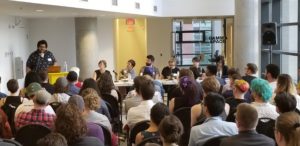
Labour issues are quickly becoming the norm in the gaming industry. Layoffs, walk-outs, crunch, poor labour conditions and abuses of power are just a few of the ongoing issues that have been reported over the past few years.
Cultural Workers Organize brought together a panel recently to explore some of the different approaches to alleviating the ongoing stresses that game workers face. The July 17 event was held at 32 Lisgar and hosted by TMAC (Toronto Media Arts Center), which has hosted many games-related events in the past
Austin Walker, an Editor of VICE Games and the host of the podcast Friends at the Table, led the event. Before his career as a critic, he studied the intersection of play and labour at the University of Western Ontario, where he was a Research Associate in the Digital Labour Group.
The other panelists were games industry researcher Johanna Weststar; Jennifer R. Whitson, whose research centres on game developers, digital media surveillance and social influences on software development; animator and experimental game designer Sagan Yee, who is Executive Director of the video game arts not-for-profit organization the Hand Eye Society; Dan Joseph, an organizer with Game Workers Unite Toronto, CWA Canada/Canadian Media Guild organizer Katherine Lapointe; and Tannara Yelland, who was co-founder of the Vice Canada union drive.
Austin Walker started the evening off by urging game workers to think critically about working conditions in the industry. “Loving games does not mean to look away from their faults or the faults in their creation,” he said. “It’s an industry where thousands work overtime so normalized that the sixty hour work week lands like a standard phrase, not like an exceptional request.”
The discussion started off with some historical context. One of the first successful labour actions in the world of video games came about in 1998, in Ottawa, Canada. Developers at Sir-Tech who were making Jagged Alliance 2 petitioned the owners of the company to do something about the crunch they were dealing with. The workers banded together and threatened a walkout and their demands were met.
“It worked in 1998, so it can work in 2019,” said Walker.
[caption id="attachment_16231" align="alignright" width="300"]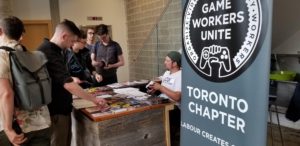 Photo by Nasr Ahmed[/caption]
The industry has changed since 1998, but the challenges are similar. While the most extreme version of crunch – 80-hour work weeks – seems to be dissipating, it has been replaced with a more constant and volatile form. This is a result of the games market moving away from individual big releases and instead concentrating on games as services – which forces developers to build and maintain all at the same time.
“The most pervasive problem for workers in the game space is the project-based nature of the work”, said Weststar. “Publishers staff up and staff down at such a clip that a lot of people in the industry rarely have stability.” The result is an industry where many don't stick around past their 30’s.
Yee said even when workers are independent – working solo or in small teams – they often run into their own version of crunch. Independent workers often suffer from the “missing producer" – a situation where they take on all responsibility for a project and don’t delegate priorities to ease the burden, elaborated Whitson.
Weststar noted that games workers can’t rely on the law to improve their working conditions. Laws can change and there are already loopholes that allow employers to hold power over employees – especially in the tech sector. Only something that is binding like a collective agreement can give workers the peace of mind they need, said Weststar
To avoid the two-tiered system of older established unions, said Lapointe,“workers need to stay active, educated and informed."
Weststar noted that since the 1970’s, neoliberal ideology has been working to convince society that individuals should be solely responsible for themselves and that relying on services and community is a sign of weakness. “Which is a lie, you need daycare, you need a pension, you need some sort of medicare.” said Weststar.
Yelland suggested that a great first step to unionization is to talk about work. Share information about wages. Open communication among your coworkers and colleagues is the only way to know how your job compares with others in the industry.
“Complain about work” said Yelland.
Finally, Walker said it’s important to organize, reach out and get active. In an industry of such size, scope and money as gaming, owners and employers will be held to account if they know their workers have a strong sense of solidarity and an understanding of their rights.
Christopher Demelo is one of the organizers of Game Workers Unite Toronto chapter. You can find him on Twitter at @capt_pudge.